

How the Dunbar Bite Scale Impacts Your Settlement Value
 Not all dog bites are treated equally under New Jersey law.
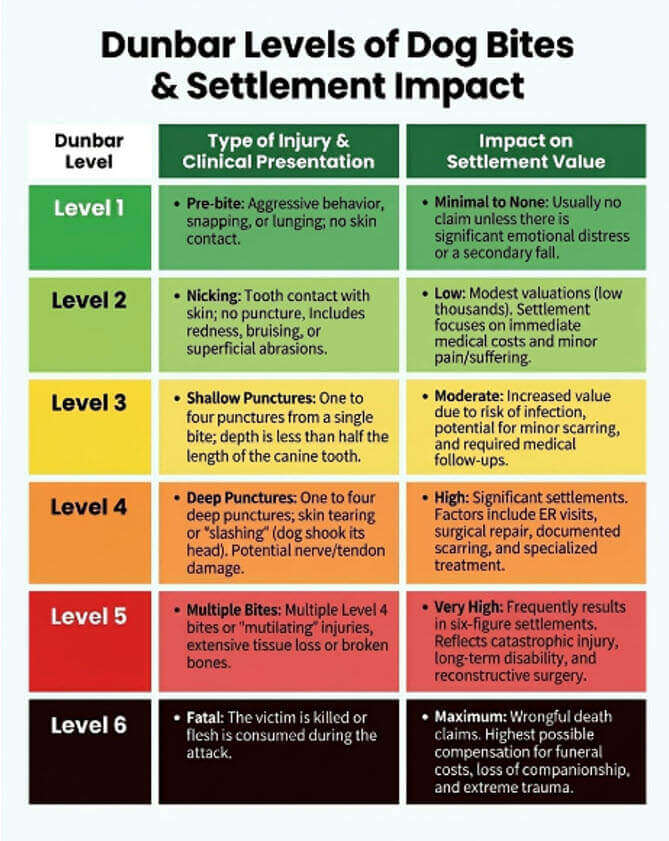
The Dunbar Bite Scale is a critical tool used by insurance adjusters and legal professionals to quantify the physical severity of an attack.
Many insurance adjusters use the Dunbar Bite Scale, a six-level classification system developed by veterinary behaviorist Dr. Ian Dunbar, to categorize the physical severity of an attack.
Level 1 refers to the pre-attack stages in which the dog shows aggression and snaps or lunges without making contact.
A Level 2 bite involves tooth contact with skin but no puncture — redness, bruising, or superficial abrasion. Adjusters typically assign these cases modest valuations, often settling in the low thousands, particularly when there is no lasting injury or documented medical treatment.
A Level 4 bite involves one to four deep punctures from a single bite, with possible tearing as the dog shakes its head. These cases involve ER visits, potential tendon or nerve involvement, and documented scarring — factors that meaningfully increase settlement value.
Severe Level 5 and 6 attacks involve multiple bites, severe tissue damage, and, in the worst cases, fatalities. These cases frequently result in six-figure settlements or verdicts, reflecting the catastrophic nature of the injuries, extensive surgical intervention, and long-term psychological harm.
New Jersey follows a strict liability statute under N.J.S.A. 4:19-16, meaning dog owners are liable for bites and dog bite injury compensation regardless of whether the dog has a history of aggression. This removes a major hurdle victims face in other states — and it means the Dunbar level of your injury maps almost directly onto compensation potential.
Not all dog bites are treated equally under New Jersey law.
The Dunbar Bite Scale is a critical tool used by insurance adjusters and legal professionals to quantify the physical severity of an attack.
Many insurance adjusters use the Dunbar Bite Scale, a six-level classification system developed by veterinary behaviorist Dr. Ian Dunbar, to categorize the physical severity of an attack.
Level 1 refers to the pre-attack stages in which the dog shows aggression and snaps or lunges without making contact.
A Level 2 bite involves tooth contact with skin but no puncture — redness, bruising, or superficial abrasion. Adjusters typically assign these cases modest valuations, often settling in the low thousands, particularly when there is no lasting injury or documented medical treatment.
A Level 4 bite involves one to four deep punctures from a single bite, with possible tearing as the dog shakes its head. These cases involve ER visits, potential tendon or nerve involvement, and documented scarring — factors that meaningfully increase settlement value.
Severe Level 5 and 6 attacks involve multiple bites, severe tissue damage, and, in the worst cases, fatalities. These cases frequently result in six-figure settlements or verdicts, reflecting the catastrophic nature of the injuries, extensive surgical intervention, and long-term psychological harm.
New Jersey follows a strict liability statute under N.J.S.A. 4:19-16, meaning dog owners are liable for bites and dog bite injury compensation regardless of whether the dog has a history of aggression. This removes a major hurdle victims face in other states — and it means the Dunbar level of your injury maps almost directly onto compensation potential.
How the Multiplier Method Works in Calculating Dog Bite Settlements
Economic damages, including your medical bills, lost wages, and future treatment costs, are relatively straightforward to calculate. The harder number to pin down is pain and suffering, and this is where the multiplier method comes in. Attorneys and adjusters typically add up all verifiable economic damages (ER bills, imaging, antibiotics, plastic surgery consultations, physical therapy) and multiply that total by a number between 1.5 and 5, depending on the severity of non-economic harm. What pushes the multiplier higher?-
PTSD and psychological trauma
-
Permanent scarring or disfigurement
-
Nerve damage and functional loss
-
Infection and complications
$18,000 (Medical) times 3.5 (Multiplier) = $63,000
Dog Bite Settlements in 2026: Understanding the Latest Insurance Data
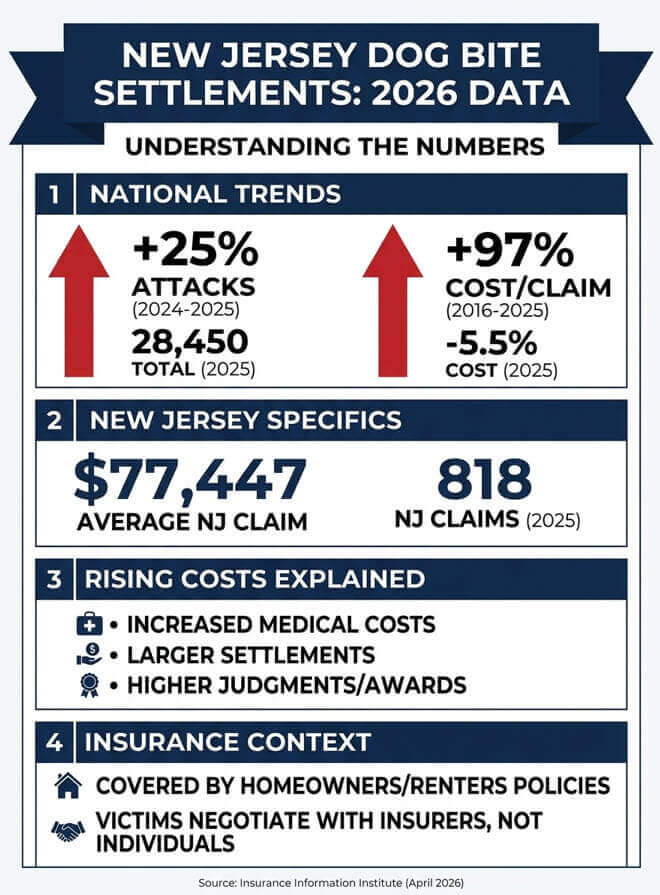 The financial stakes in dog bite litigation have risen considerably in recent years. According to the latest data from the Insurance Information Institute released in April 2026, the number of dog bites rose 25% from 2024 to 2025, with 28,450 dog attacks nationally last year.
While the average cost per dog bite claim decreased 5.5% in 2025, the average cost per claim nationally has risen 97% from 2016 to 2025, due to increased medical costs, the size of settlements, judgments, and jury awards given to plaintiffs, which are trending up.
New Jersey, with its strict liability framework and relatively plaintiff-friendly legal environment, tends to produce settlements that meet or exceed the national average for moderate-to-severe cases. The recently released Insurance Information Institute data shows the average New Jersey dog bite claim reached $77,447, with 818 insurance claims for dog attacks across the Garden State in 2025.
It’s worth noting that homeowners and renters insurance policies in New Jersey typically cover dog bite liability, which means most victims ultimately negotiate with an insurer rather than an individual.
The financial stakes in dog bite litigation have risen considerably in recent years. According to the latest data from the Insurance Information Institute released in April 2026, the number of dog bites rose 25% from 2024 to 2025, with 28,450 dog attacks nationally last year.
While the average cost per dog bite claim decreased 5.5% in 2025, the average cost per claim nationally has risen 97% from 2016 to 2025, due to increased medical costs, the size of settlements, judgments, and jury awards given to plaintiffs, which are trending up.
New Jersey, with its strict liability framework and relatively plaintiff-friendly legal environment, tends to produce settlements that meet or exceed the national average for moderate-to-severe cases. The recently released Insurance Information Institute data shows the average New Jersey dog bite claim reached $77,447, with 818 insurance claims for dog attacks across the Garden State in 2025.
It’s worth noting that homeowners and renters insurance policies in New Jersey typically cover dog bite liability, which means most victims ultimately negotiate with an insurer rather than an individual.
Why Early Settlement Offers from Insurance Companies Are Almost Always Too Low to Compensation for Dog Bite Injuries
Here is one of the most important elements to understand before you accept any settlement: early settlement offers are designed to close your case before the full picture of your damages is known. Insurance adjusters are trained to contact victims quickly — sometimes within days of a bite — when the emotional shock is fresh, and the full medical trajectory is still unclear. An offer made two weeks after an attack cannot account for:- Plastic surgery costs that may only be recommended months later, once scarring has fully formed
- Infection complications that can develop over weeks and require additional hospitalization
- PTSD diagnoses that typically emerge after an initial assessment period with a mental health professional
- Ongoing physical therapy for nerve or tissue damage