
A child’s face heals differently from an adult’s. It’s thinner skin, closer to the bone, and still years away from finishing its growth. This is exactly why a dog bite to a child’s cheek, lip, or eyelid so often leaves a permanent mark. If your son or daughter was bitten and left with a scar, you’re probably asking two things: does New Jersey law actually account for what this will mean for my child at 10, at 16, at 30, and how much is that worth?
Short answer: New Jersey is one of the more victim-friendly states in the country when it comes to dog bites. Under N.J.S.A. 4:19-16, the dog’s owner is strictly liable the moment the bite happens. You don’t have to prove the owner was careless or that the dog had bitten before.
Disfigurement is treated as its own category of compensable harm. New Jersey courts and insurance companies have to account for scarring separately from medical bills, factoring in the psychological toll, the likelihood of future surgery, and the fact that a scar on a growing child can change shape and position for years after the attack.
This article is for parents and guardians of a New Jersey child who was bitten by a dog and left with a visible scar, keloid, or other permanent mark, and who want to understand their legal options before talking to an insurance adjuster.
Why New Jersey’s Strict Liability Law Matters for Scarring Claims
Most personal injury cases require you to prove the other party was negligent. Dog bite cases in New Jersey don’t work that way.
Under N.J.S.A. 4:19-16, a dog owner is liable for a bite if the victim was in a public place or lawfully in a private place, including the owner’s own property.
The statute doesn’t ask whether the dog ever bit anyone before, nor whether the owner had any reason to believe the dog was dangerous. This is a first-bite liability rule, and it puts New Jersey dog bite law ahead of the two dozen states that still follow some version of the “one bite” rule, under which a victim must show the owner knew the dog was capable of aggression.
For a family dealing with a child’s facial scar, it means the case doesn’t turn into a fight over the dog’s history or the owner’s intentions. The only question is: what is this injury actually worth? That’s where the disfigurement analysis comes in.
What Counts as “Disfigurement” Under New Jersey Law
Disfigurement isn’t a single item on a settlement sheet. It counts as a category of non-economic damages that overlaps with medical expenses and pain and suffering. New Jersey law recognizes a permanent scar as compensable harm because a scar continues causing loss long after the wound itself has closed.
Injuries that typically qualify as disfigurement in a New Jersey dog bite case include:
- Permanent or long-lasting scars, especially on the face, neck, ears, or hands
- Keloid or hypertrophic (raised) scarring
- Skin discoloration or texture changes from the bite or from grafting
- Tissue loss requiring reconstructive surgery, including partial amputations
- Asymmetry caused by muscle or nerve damage beneath the bite site
- Permanent hair loss at the wound site (common with scalp bites)
Unlike a routine cut, a dog bite involves tearing and crushing force rather than a clean laceration, which is why these wounds heal irregularly and are so much more likely to leave a permanent mark than a comparable knife or glass injury.
Why Children’s Scars Are Treated Differently
Juries and insurance adjusters alike tend to weigh a child’s disfigurement more heavily than an adult’s, and there are concrete reasons for that beyond sympathy.
- Children are bitten in more visible places
Because of their height, a child is frequently at eye level with a dog’s mouth, which is why facial bites are so disproportionately common in kids under 10.
- A scar on a growing child doesn’t stay the same
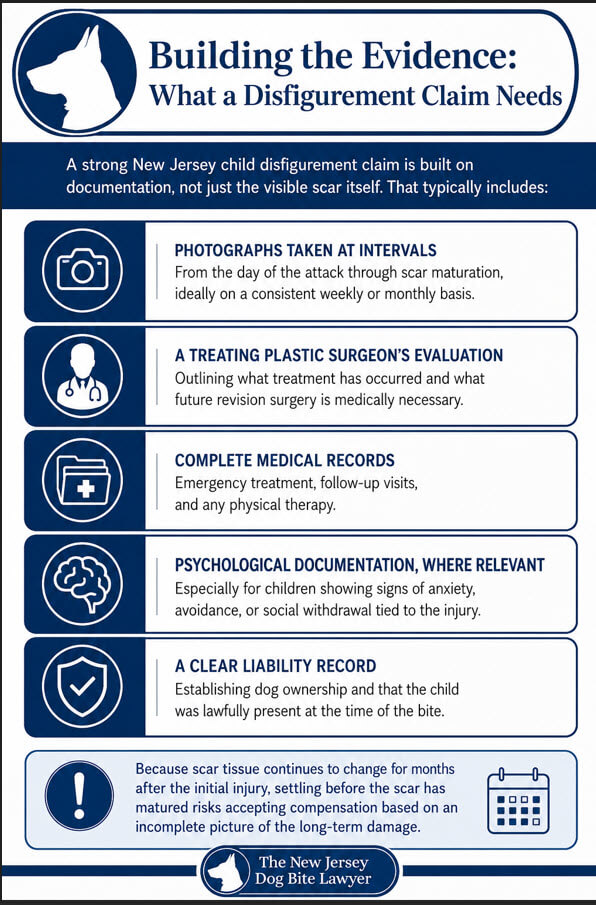
As a child’s bone structure and skin stretch through adolescence, a scar can migrate, widen, or pull at surrounding tissue. A cheek scar acquired at age four may sit differently on the face by age fourteen. This unpredictability is one of the reasons attorneys wait for a scar to mature, typically 6 to 12 months, before valuing a claim.
- Multiple surgeries are common
A single revision surgery in early childhood is often not the end of treatment. Plastic surgeons frequently recommend follow-up procedures as the child grows, meaning a settlement negotiated too early may fail to account for care that hasn’t happened yet. This is also why it’s vital to speak with both lawyers and medical professionals within the first 24 hours after your child’s dog attack.
- The psychological impact compounds during development
Body image, social anxiety, and the reality of childhood bullying are all well-documented consequences of visible scarring, and they surface more acutely during the school years than they might for an adult victim.
Because of this, a New Jersey dog bite claim involving a child often includes input from a treating plastic surgeon and, in more serious cases, a psychologist who can speak to the emotional and developmental effects. Evidence from both of these specialists forms part of the record used to justify a higher settlement.
How A Child’s Disfigurement Affects Dog Bite Settlement Value
There’s no fixed formula in New Jersey for pricing a scar, but several factors consistently move the number:
| Disfigurement Factor | Why It Matters |
| Location of the scar | Face, neck, and hands carry more weight than scars on covered areas of the body |
| Severity and size | Deeper, wider, or more textured scars generally increase value |
| Age of the victim | Children tend to receive higher valuations due to the developmental and psychological impact |
| Need for future surgery | Anticipated revision procedures are factored into both economic and non-economic damages |
| Permanence | A scar expected to fade is valued differently than one that is permanent |
| Psychological effects | Documented anxiety, social withdrawal, or PTSD symptoms increase claim value |
| Insurance policy limits | The dog owner’s homeowner’s or renter’s policy limit can cap what’s realistically recoverable |
In cases with clear, well-documented disfigurement, child dog bite settlement data shows that settlements involving facial scarring or long-term trauma can exceed $250,000, and New Jersey cases follow that same pattern when the injury and its documentation support it.
The Court Approval Process for a Minor’s Settlement
Even after a fair number is reached, a New Jersey dog bite settlement involving a child can’t simply be paid out. Because a minor cannot legally sign a release, the law requires additional court oversight before any settlement becomes final.
- A parent or guardian ad litem brings the claim.
Minors can’t file a lawsuit on their own behalf, so a parent, legal guardian, or court-appointed guardian ad litem acts for the child throughout the case.
- A judge must approve the settlement in a “friendly hearing.”
Before any settlement is finalized, a New Jersey judge reviews the terms at what’s known as a friendly hearing to confirm the amount is genuinely in the child’s best interest, not just convenient for the adults handling the case.
- Settlement proceeds over $5,000 are protected.
Recovered funds are typically deposited with the Surrogate’s Court, held in a restricted account, or placed into a structured settlement or annuity, rather than handed directly to a parent. Withdrawals generally require court approval and proof that the funds are being used for the child’s benefit.
- The money is preserved until adulthood.
Whether held by the Surrogate’s Court or structured as an annuity, the goal is the same: protecting the compensation for future medical care, therapy, or education when the child turns 18.
This process adds a layer of complexity that most personal injury cases don’t have, and it’s one more reason families benefit from an attorney who has actually handled friendly hearings and Surrogate’s Court filings before, not just dog bite claims generally.
Answers to Your Dog Bite Disfigurement Questions
How long does a scar have to heal before we can settle the case?
Most attorneys recommend waiting until the scar has fully matured — generally 6 to 12 months after the injury — before finalizing a settlement, since scars can continue to change in appearance during that period.
Does the settlement money go directly to my child?
Not immediately. New Jersey requires court approval of any minor’s settlement through a “friendly hearing,” and proceeds over $5,000 are generally held by the Surrogate’s Court or placed in a structured settlement until the child reaches adulthood.
What if my child was partly to blame for provoking the dog?
New Jersey courts presume children under seven were not negligent, and that presumption is nearly irrebuttable for children four and under. For older children, comparative negligence could reduce, but rarely eliminate, a recovery.
Can we claim compensation for over-the-counter scar treatments?
Yes, you can include the out-of-pocket costs for silicone sheets, daily scar massage therapies, and specialized sunscreens in your economic damages.
What happens if the dog owner lacks enough insurance to cover the scar treatments?
If the homeowner policy limit is too low to cover extensive facial reconstructive surgeries, your attorney can investigate umbrella policies or the personal assets of the dog owner.
What happens if my child suffers nerve damage under the scar?
Deep bites often crush facial nerves. This can cause a permanent loss of sensation or facial asymmetry. Your attorney will use neurological evaluations to increase the value of the injury claim.
Talk to a New Jersey Dog Bite Attorney Experienced in Child Disfigurement Claims
David J. Cowhey has spent over three decades focused specifically on New Jersey litigation, including cases involving permanent scarring. His partner at The New Jersey Dog Bite Lawyer firm, Rob Morrello, has 17 years of experience fighting for the rights of child victims throughout the state.