
A facial dog bite is far more than a painful injury. It can permanently alter a person’s appearance, require years of reconstructive treatment, and leave lasting emotional scars that affect every aspect of life. For children, who are the most common victims of facial dog attacks because their faces are often at the same height as a dog’s head, these injuries can have lifelong physical, emotional, and financial consequences.
This guide explains the medical realities of facial injuries, New Jersey’s strict liability law, how settlements are calculated, and what you should do to protect your rights after an attack.
Why Facial Dog Bite Injuries Are Different
Unlike bites to the arms or legs, facial injuries often result in permanent cosmetic damage and functional impairments. The face contains delicate nerves, muscles, blood vessels, and sensory organs that can all be affected by a single attack.
Even with exceptional medical care, many victims require multiple procedures to restore both appearance and function.
| Facial Dog Bite Injury | Potential Long-Term Impact |
| Deep facial lacerations | Permanent visible scarring |
| Torn lips or cheeks | Reconstructive surgery |
| Nerve damage | Loss of facial movement or sensation |
| Eye injuries | Partial or permanent vision loss |
| Broken facial bones | Extensive surgical repair |
| Infection | Delayed healing and additional treatment |
The emotional impact can be equally devastating. Victims frequently struggle with anxiety, depression, post-traumatic stress disorder (PTSD), fear of dogs, and reduced self-confidence. For example, a study published by the National Library of Medicine found a statistically significant correlation between facial scars and PTSD.
Children may become withdrawn at school, avoid social situations, or develop lasting emotional trauma that follows them into adulthood.
Why Children Are the Most Common Victims of Facial Injuries
Children account for a large percentage of serious facial dog bite injuries. Their height naturally places their faces within striking distance of many dogs, and younger children often cannot recognize the warning signs that a dog feels threatened or uncomfortable.
Several factors increase a child’s risk:
- Their face is often level with the dog’s mouth.
- They may hug or approach dogs unexpectedly.
- They frequently misinterpret aggressive body language.
- They cannot react quickly enough to avoid an attack.
- Facial tissues are still developing, increasing the need for future surgeries.
A child who suffers permanent facial scarring may require reconstructive procedures for years as their face grows. Beyond the medical treatment, the emotional effects can influence confidence, friendships, education, and future career opportunities. Our guide to securing compensation in facial scarring and disfigurement in child dog attack cases covers the topic in greater depth.
Who Pays for Facial Dog Bite Injuries In New Jersey?
One of the most common concerns people have is whether filing a claim will financially harm a friend, neighbor, or family member whose dog caused the injury.
Fortunately, that is rarely how these cases work.
Most dog bite settlements in New Jersey are paid through liability insurance, including:
- Homeowner’s insurance
- Renter’s insurance
- Personal umbrella liability policies
The insurance company, not the individual dog owner, typically provides the compensation available under the policy limits. These policies exist specifically to protect both homeowners and injured victims when accidents occur.
Understanding this often helps families feel more comfortable pursuing the compensation needed for medical treatment, therapy, and future care.
Medical Treatment Following a Facial Dog Bite
The high risk of infection, permanent scarring, and functional impairment associated with facial dog bites means that victims require urgent medical care.
Treatment may include:
- Emergency wound care: Thoroughly cleaning the wound, controlling bleeding, and carefully closing lacerations to reduce the risk of infection and minimize scarring.
- Plastic surgery: Repairing damaged skin and tissue while preserving the natural appearance of the face whenever possible.
- Reconstructive surgery: Restoring facial structures that have been severely damaged by the attack, including muscles, cartilage, and soft tissue.
- Nerve repair: Addressing damage to facial nerves that may affect movement, sensation, smiling, blinking, speaking, or eating.
- Scar revision procedures: Improving the appearance of scars through additional surgeries, laser treatments, or other cosmetic procedures as healing progresses.
- Psychological counseling: Helping victims cope with PTSD, anxiety, depression, fear of dogs, and the emotional effects of permanent facial disfigurement.
Many victims require additional surgeries months or even years after the initial injury. Children, in particular, may need further reconstructive procedures as their facial bones and soft tissues continue to develop. Medical records documenting every stage of treatment are also critical evidence when pursuing compensation for both current and future medical expenses.
How Are Facial Dog Bite Settlements Calculated Under New Jersey Law?
There is no standard settlement amount for a facial dog bite injury in New Jersey. Every case is valued based on the severity of the injuries and the long-term impact they will have on the victim’s life.
Because facial injuries often involve permanent disfigurement, multiple surgeries, and significant emotional trauma, they frequently result in higher settlements than bites to other parts of the body.
The value of a claim is determined by several important factors, including:
- Permanent facial scarring and disfigurement
Highly visible scars, tissue loss, and permanent changes to a person’s appearance often represent one of the largest components of a settlement.
- Future medical care
Compensation may include the cost of reconstructive plastic surgery, scar revision procedures, laser treatments, nerve repair, and any additional surgeries recommended by treating physicians. Future medical treatment is central to most child dog bite injury claims, requiring analysis from pediatricians and plastic surgeons to determine potential future treatment scope.
- Pain and suffering
Victims may recover damages for the physical pain associated with the attack, emergency treatment, surgeries, and lengthy recovery periods.
- Emotional and psychological trauma
PTSD, anxiety, depression, fear of dogs, social embarrassment, and diminished self-confidence are all recognized damages when supported by medical or mental health evidence.
- Lost wages and diminished earning capacity
If the injuries prevent a victim from working or permanently affect future employment opportunities, those financial losses may also be recoverable.
- Past and future medical expenses
Emergency treatment, hospitalization, rehabilitation, counseling, prescription medications, and ongoing medical care are all considered when calculating compensation.
Unlike many states, New Jersey does not impose statutory caps on compensatory damages. This allows victims to pursue compensation that reflects the full physical, emotional, and financial impact of a catastrophic facial dog bite injury.
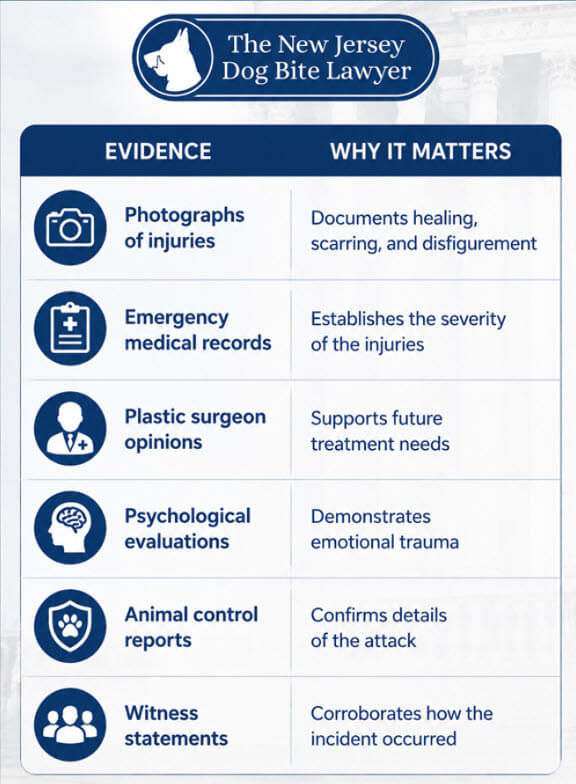
Evidence That Can Strengthen Your Facial Dog Bite Claim
Building a successful dog bite case requires more than simply showing that an attack occurred. Strong evidence helps demonstrate both liability and the full extent of the victim’s damages. The sooner this evidence is preserved, the stronger your claim is likely to be.
Answers to Your Facial Dog Bite Injuries Questions from Our Attorneys
How does a New Jersey “Friendly Hearing” impact a minor’s settlement for permanent facial scarring?
When a child suffers a severe dog bite, parents cannot simply accept a check directly from the insurance company. Under New Jersey Court Rule 4:44, any settlement for a minor must be approved by a judge during a “Friendly Hearing”. The judge will review medical evaluations from plastic surgeons to ensure the compensation is fair and adequately covers future scar revisions. The funds are then typically placed in a protected county Surrogate’s interfund account or a structured annuity until the child turns 18.
Under N.J.S.A. 4:19-16, can an owner avoid paying for my facial reconstructive surgery by claiming I provoked the dog?
New Jersey is a strict liability state for dog bites, meaning the owner is automatically responsible if you were bitten in a public place or lawfully on private property. However, the insurance company can try to fight your claim by proving an exception to the rule—specifically, that you were trespassing or that you deliberately provoked the dog. If the defense successfully proves willful provocation, your compensation for surgery and trauma could be significantly reduced.
Why is the 12-to-18-month scar maturation timeline critical before settling a facial dog bite claim in New Jersey?
Facial tissue heals differently and is much more sensitive than other parts of the body. Plastic surgeons generally agree that a facial scar takes 12 to 18 months to fully “mature” (flatten and fade to its permanent state). If you settle your New Jersey claim before this maturation period ends, you might not secure enough money to cover future, specialized procedures like laser resurfacing, Z-plasty, or skin grafting that only become apparent as necessary after the scar fully sets.
What happens to my settlement if the dog owner’s New Jersey homeowner’s policy has an “animal liability exclusion” or a breed-specific sub-limit?
While most claims are paid through homeowner’s or renter’s insurance, many modern New Jersey policies include exclusions for specific breeds (often Pit Bulls, Rottweilers, or Akitas) or cap animal-related payouts at a low sublimit (e.g., $25,000). Facial reconstruction and plastic surgery can easily exceed these limits. If an exclusion applies, you may need to look for a secondary umbrella insurance policy, pursue compensation from a landlord (if they allowed a known dangerous dog on the premises), or hold the dog owner personally liable for the remaining out-of-pocket medical bills.
How are non-economic damages calculated in New Jersey for the specific psychological trauma linked to facial disfigurement?
Unlike a bite on a concealed part of the body, a facial injury is visible every time you look in the mirror and often leads to severe social anxiety, depression, or PTSD. In New Jersey, you are entitled to “non-economic damages” (pain and suffering). To secure maximum compensation for a facial injury, attorneys rely heavily on formal psychological evaluations and “day-in-the-life” impact statements. The victim’s age, the exact location of the scar (e.g., across the lip versus under the chin), and documented medical evidence are crucial factors behind case value.
How much does it cost to hire The New Jersey Dog Bite Lawyer?
There are no upfront legal fees. David J. Cowhey and Rob Morello handle dog bite cases on a contingency fee basis, meaning you pay nothing unless they recover compensation on your behalf.
Schedule a Free Review of Your Facial Dog Bite Claim
A facial dog bite can leave lifelong physical and emotional scars, but you do not have to face the recovery process alone. Whether your injuries involve reconstructive surgery, permanent facial disfigurement, nerve damage, or lasting psychological trauma, experienced legal representation can make a meaningful difference in the outcome of your claim.
David J. Cowhey and Rob Morello have dedicated their careers exclusively to representing dog bite victims throughout New Jersey. The New Jersey Dog Bite Lawyer firm has a proven record of seven-figure results in facial injury claims and has represented families in cities throughout the Garden State.
If you or your child has suffered a facial dog bite injury, call The New Jersey Dog Bite Lawyer at (609) 513-0627 to discuss your legal options or schedule a free, no-obligation case review.