
If your child’s dog bite scar may need surgery years from now, the settlement has to pay for it today. A child’s injury case in New Jersey is usually resolved once, with a judge’s approval. Any care not documented and included at that point is generally gone.
This guide explains why surgeons often wait to revise a child’s scar, how dog bite attorneys can help prove future surgery costs, and how the court protects that money until it’s needed.
Why Surgeons Often Wait Until the Scar (or the Child) Matures
A scar is not finished when the stitches come out. For many months it stays red, raised, and firm, then slowly flattens and fades as the tissue remodels. Revising it too early can mean operating on tissue that would have improved on its own, or cutting into a scar that is still changing.
That’s why timing matters so much with facial dog bite injuries in children. In a study of 107 children treated for facial dog bites, most families (77%) chose scar revision between 9 and 18 months after the first treatment. The authors also noted that these injuries often need more than one revision to get the best result (Eppley et al., Journal of Craniofacial Surgery, 2013).
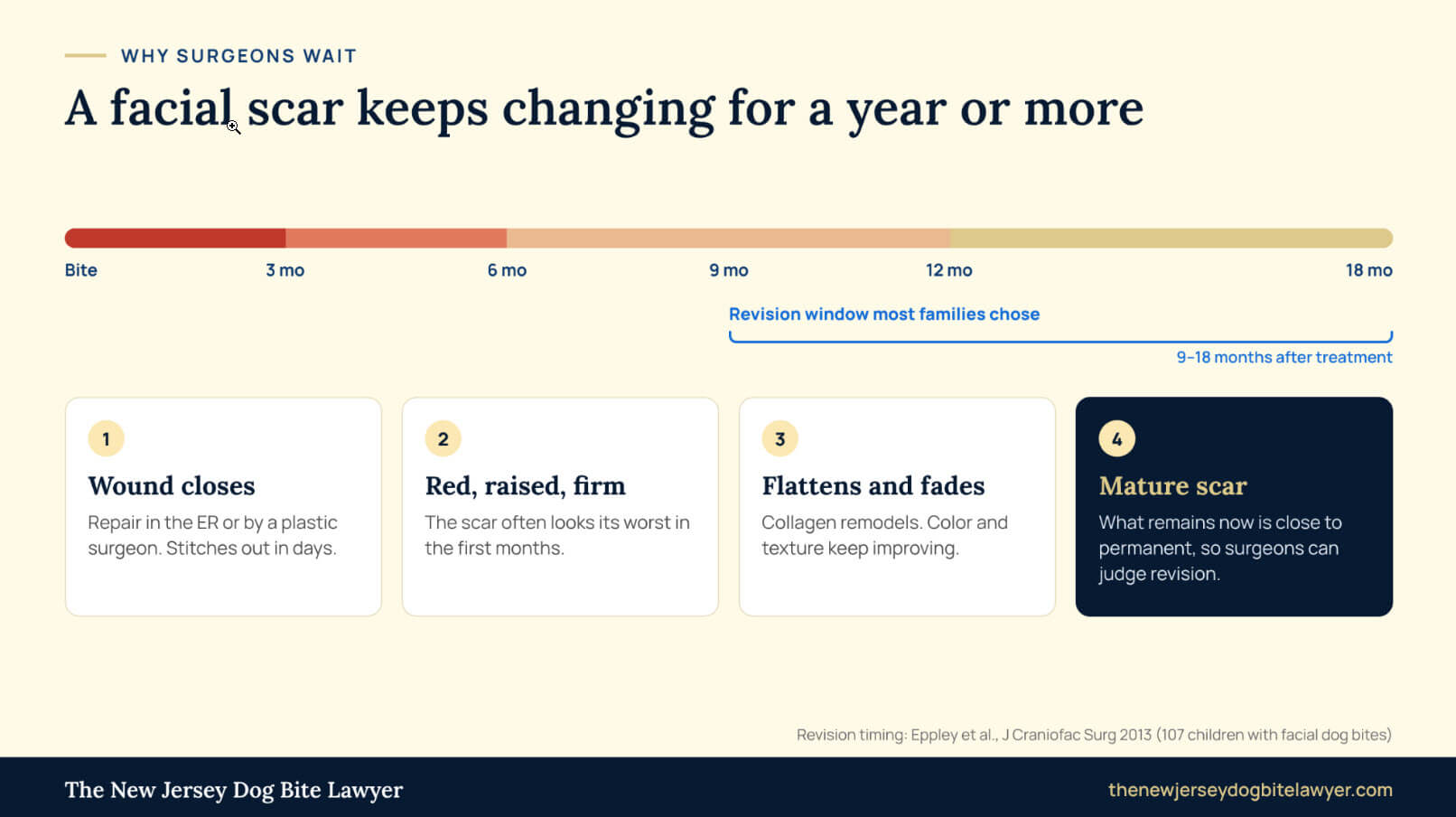
A scar keeps changing for a year or more. Surgeons usually judge revision once it has matured.
Other reasons a surgeon may plan revision for later:
- Growth. A child’s face changes shape as they grow, which can stretch or shift a scar. Some revisions are planned for the teenage years.
- Cooperation. Older children can hold still, follow aftercare, and protect the scar from the sun, which affects the result.
- Staged treatment. Larger scars may need several procedures spaced months apart.
Common Scar Treatments and When They’re Typically Used
| Treatment | Typical Timing | What it Means for the Claim |
| Silicone gel or sheets, sun protection | Early months of healing | Ongoing costs parents pay now. Keep receipts. |
| Steroid injections | When a scar becomes thick or raised | Often a series of visits. Each one should be documented. |
| Laser treatments | After initial healing, often repeated | Several sessions may be recommended over time. |
| Surgical scar revision (excision, Z-plasty, W-plasty) | Usually after the scar matures, sometimes years later | The highest future cost. Needs a surgeon’s written recommendation. |
| Grafts or flaps | Complex injuries with tissue loss | May involve multiple stages and longer recovery. |
Your child’s plastic surgeon decides which treatments fit. This table is general information, not medical advice.
How Future Surgery Costs Are Proven
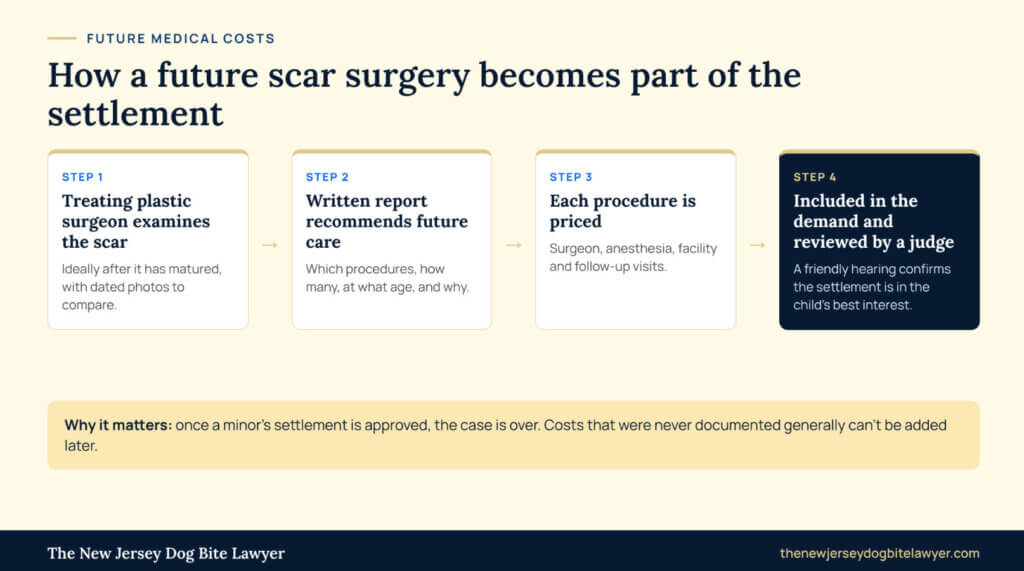
An insurance company won’t pay for a surgery just because a parent expects one. The need has to be backed by medical evidence. In most cases, that starts with the treating plastic surgeon.
Future surgery has to be documented before the case settles.
| Evidence | What it shows | Who provides it |
| Surgeon’s written report | Which procedures are recommended, how many, at what age, and why | Treating plastic surgeon |
| Cost estimates | Surgeon, anesthesia, facility, and follow-up costs for each procedure | Surgeon’s office or hospital |
| Dated photographs | How the scar looked at the time of the bite, during healing, and after it matured | Parents and the medical team |
| Medical records and bills | Treatment already given and what it cost | ER, surgeon, pediatrician |
| Expert medical report (if the case is in litigation) | An independent opinion on permanency and future care | Retained medical expert |
Future surgery is only part of the claim. A visible, permanent scar on a child’s face also supports compensation for disfigurement, pain, and emotional distress. Our guide to suing for plastic surgery costs after a dog bite explains those costs in more detail.
Friendly Hearings: How the Court Protects the Child’s Compensation
In New Jersey, a settlement for a minor must be approved by a judge at a friendly hearing under Court Rule 4:44.
The judge reviews the physician reports and must be satisfied that the settlement is fair, reasonable, and in the child’s best interest (NJ Courts Directive #9-08). Documented future surgery shows the judge that the amount accounts for the care the child still needs.
Once approved, the money is usually deposited with the county Surrogate and held until the child reaches adulthood, or paid through a structured settlement. Funds held by the Surrogate can only be withdrawn early with a further court order. That matters if a revision is scheduled before your child turns 18, so it’s important to plan for it with your attorney.
What Parents Can Do Now to Protect Their Child’s Dog Bite Scar Claims
- Photograph the scar on the same date each month, in the same light.
- Keep every follow-up appointment with the plastic surgeon.
- Ask the surgeon directly: “Will she need more procedures, and when?”
- Save receipts for scar creams, silicone sheets, and travel to appointments.
- Don’t accept an early offer from the insurance company before the scar has matured.
Over 40 years of dog bite law experience is just a phone call away. If your child has a facial scar from a dog bite, contact the New Jersey Dog Bite Lawyer team of David Cowhey and Rob Morello for a free consultation.
Dog Bite Scarring Compensation: Your Legal Questions Answered
Can we reopen the case if my child needs another surgery later?
Generally, no. Once a minor’s settlement is approved, the claim is closed. That’s why future surgery should be documented and included before the case settles.
Should we settle before the scar has fully healed?
Usually no. Until the scar matures, no one can say with confidence how it will look or what treatment it will need. Settling early risks leaving out the cost of future care.
How do we pay for a revision before our child turns 18?
If the settlement is held by the county Surrogate, your attorney can ask the court for an order releasing funds for the surgery. A structured settlement can also be designed with payments timed for expected care.
Will health insurance cover scar revision?
Some health plans treat scar revision as cosmetic and limit coverage. The dog owner’s liability insurance is responsible for the cost of the injury, which is one reason the settlement should account for it.