
Few situations are more emotionally challenging than watching your child suffer a dog bite during what should have been a happy visit with friends or family.
Whether the attack happens at a grandparent’s home, during a birthday party, or while visiting close family friends, parents are often left with two immediate concerns: one, making sure their child receives proper medical care, and two, deciding whether pursuing compensation will damage an important relationship.
Many parents are surprised to learn that a dog bite claim involving a relative or close friend is often handled very differently than they imagined. In many cases, compensation comes through the dog owner’s homeowner’s insurance policy rather than directly from the family member’s personal finances.
Understanding how New Jersey law works can help parents make informed decisions that prioritize their child’s long-term recovery while preserving family relationships whenever possible.
Why Family Dog Bite Cases Are Different
Dog attacks involving family members often create a unique emotional dilemma.
Parents may hesitate to pursue a claim because they worry about causing financial hardship for grandparents, siblings, or lifelong friends. However, serious dog bite injuries can require emergency treatment, plastic surgery, counseling, and years of follow-up care. Ignoring these future costs can place a significant financial burden on the injured child’s family.
Unlike a dispute between strangers, many family dog bite claims begin with a conversation about insurance coverage rather than litigation. Homeowner’s liability insurance is designed to protect both the policyholder and guests who suffer unexpected injuries on the property.
While every insurance policy is different, many dog bite claims are resolved through insurance negotiations instead of requiring a relative to personally pay a settlement.
New Jersey Law and Family Dog Attacks
| Legal Element | New Jersey Law | What It Means for Families |
| Liability for dog bites | New Jersey follows a strict liability rule under N.J.S.A. 4:19-16. | The owner may be responsible even if the dog never bit anyone before. |
| Prior aggressive behavior | Generally not required. | A first-time bite can still result in liability. |
| Lawful presence | The injured child must have been lawfully on the property. | Invited guests, relatives, and children attending family gatherings are often covered. |
| Insurance | Many claims are paid through homeowner’s or renter’s insurance. | Compensation often comes from insurance instead of the relative personally. |
| Child settlements | Courts generally review dog bite settlements involving minors. | Judicial approval helps ensure the settlement protects the child’s interests. |
The Role of New Jersey’s Strict Liability Rule
New Jersey has one of the most victim-friendly dog bite statutes in the country.
Rather than requiring an injured person to prove the owner knew the dog was dangerous, the law generally holds owners responsible when their dog bites someone who was lawfully on public property or lawfully visiting private property.
This is particularly important in family situations because many serious attacks involve dogs that have never shown signs of aggression. A grandparent’s dog may have lived peacefully around children for years before unexpectedly reacting to loud noises, unfamiliar visitors, food, or another stressful situation.
Under New Jersey’s dog bite laws, the absence of previous attacks does not necessarily prevent an injured child from recovering compensation.
How Insurance Works in Family Dog Bite Claims
One of the biggest misconceptions surrounding family dog attacks is that filing a claim means suing a loved one personally. In reality, many cases begin with a claim submitted to the homeowner’s insurance company. The insurer investigates the incident, reviews medical records, and negotiates any potential settlement.
This distinction matters because homeowner’s insurance exists specifically to provide financial protection when unexpected accidents occur. While each policy has its own terms, exclusions, and liability limits, insurance is frequently the primary source of compensation for injured guests.
Coverage depends on the language of the applicable insurance policy and the specific facts of the claim.
What Homeowner’s Insurance May Cover After a Child Dog Bite
| Damages and Expenses | Often Covered by Homeowner’s Insurance | Important Considerations |
| Emergency Medical Care | Ambulance transportation, emergency room treatment, physician evaluations, stitches, wound cleaning, medications, and initial hospitalization. | Immediate medical care creates important documentation for both treatment and the insurance claim. |
| Hospital Bills & Follow-Up Care | Surgery, specialist visits, imaging, follow-up appointments, infection treatment, rehabilitation, and prescription medications. | Serious bites often require treatment from multiple specialists over several months. |
| Plastic & Reconstructive Surgery | Initial reconstructive procedures, facial surgery, skin grafts, and medically necessary cosmetic reconstruction. | Children may require multiple procedures as they grow and facial structures develop. |
| Future Scar Revision Procedures | Scar revision surgery, laser treatments, dermatology care, and additional reconstructive procedures recommended by physicians. | Future treatment should be evaluated before accepting a settlement because additional procedures may not occur for years. |
| Psychological Counseling | Therapy for anxiety, PTSD, nightmares, fear of dogs, emotional trauma, or social anxiety resulting from visible scarring. | Emotional injuries can be just as significant as physical injuries, particularly for young children. |
| Pain and Suffering | Compensation for physical pain, emotional distress, inconvenience, and the overall impact the injuries have on the child’s quality of life. | This is a non-economic damage and is evaluated based on the severity and long-term effects of the injury. |
| Permanent Facial Scarring & Disfigurement | Compensation for permanent visible scars, disfigurement, and loss of normal appearance. | Facial injuries involving children often increase the value of a claim because the effects may last a lifetime. |
| Future Medical Expenses | Anticipated surgeries, future physician visits, counseling, therapy, medications, and long-term medical care supported by expert opinions. | Settlements should account for expected future costs, not just bills already incurred. |
| Parental Financial Losses | In some cases, reimbursement for a parent’s out-of-pocket expenses or lost income while caring for the injured child. | Availability depends on the facts of the case and the applicable law. |
How to Build a Strong Child Dog Bite Claim
Every child recovers differently after a dog attack. While some injuries heal within weeks, others may leave permanent scars or emotional trauma that continues for years.
Because children are still growing, physicians may recommend delaying certain reconstructive procedures until later in adolescence, making it important to evaluate both current and future medical needs before resolving a claim.
To ensure that a settlement reflects the full scope of your child’s future treatment rather than just immediate medical expenses, parents can take active steps to document the recovery.
- Document the recovery from day one
Keep a detailed timeline of your child’s healing process, treatments, and daily struggles.
- Take consistent photographs
Capture the injuries immediately and take regular photos over time to visually demonstrate how the wounds are healing or scarring.
- Compile all medical records
Retain copies of every emergency room bill, prescription, and follow-up appointment receipt.
- Seek specialist evaluations
Obtain written recommendations from plastic surgeons or pediatric specialists regarding any delayed reconstructive procedures.
- Address emotional trauma
Secure evaluations and treatment records from mental health professionals to prove the psychological impact of the attack.
- Account for future costs
Work with your medical team and legal counsel to ensure the claim calculates the cost of long-term care, not just the bills you have already incurred.
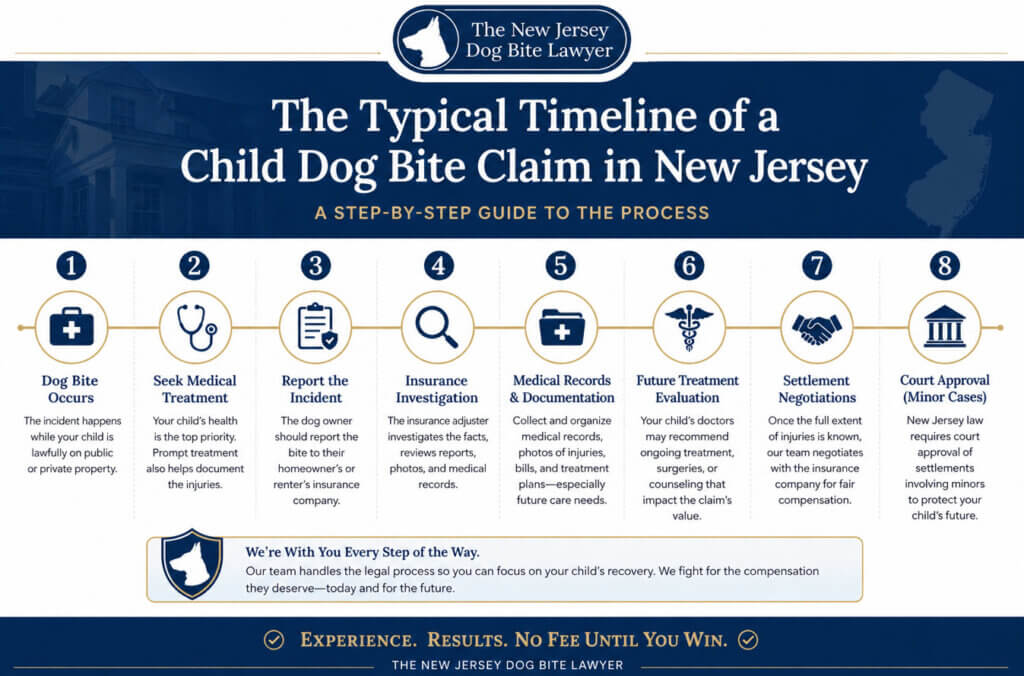
Timeline for Child Dog Bite Claims in New Jersey
Looking Beyond Immediate Medical Bills
Parents naturally focus on emergency care immediately after a dog attack, but the long-term consequences often become apparent months later. Facial scars may require multiple revision procedures.
Some children develop anxiety around dogs, nightmares, or social anxiety because of visible scars. These long-term effects are legitimate components of a personal injury claim and should be carefully considered before accepting an early settlement offer.
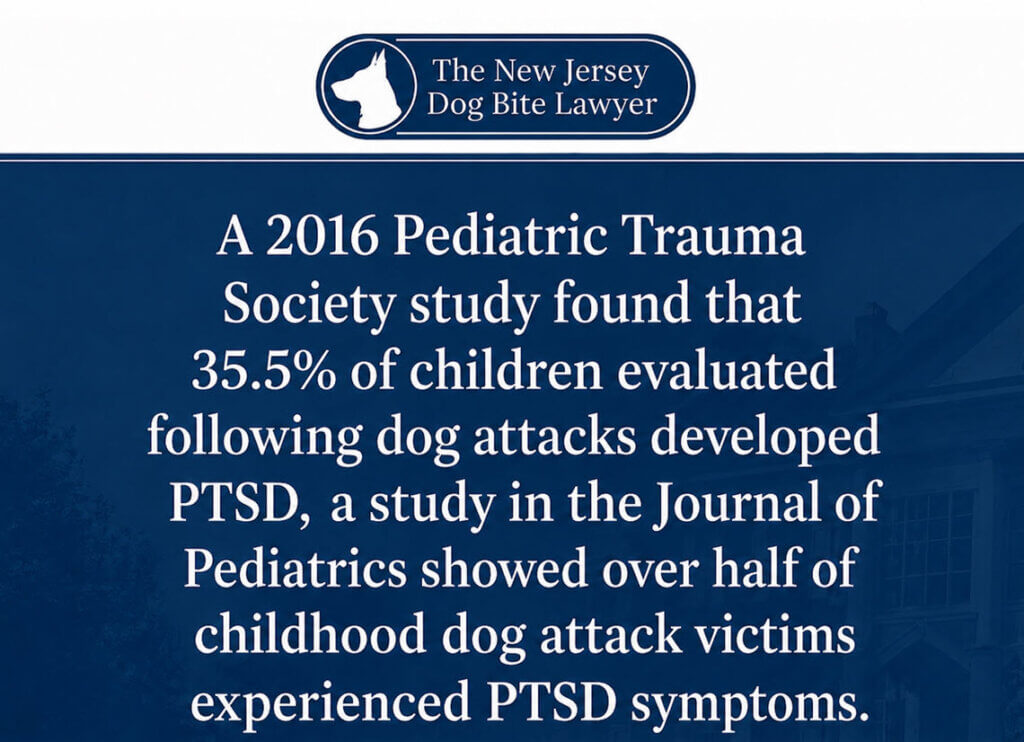
Insurance companies may attempt to resolve claims shortly after an incident, before physicians can fully assess whether additional surgeries or therapy will be necessary. Waiting until the child’s prognosis is better understood often provides a clearer picture of future damages.
Schedule a Free Consultation with the New Jersey Dog Bite Lawyer After an Attack Involving a Family Dog
If your child has been attacked by the dog of a family member or friend, you need dog bite lawyers who understand the urgent and sensitive nature of your potential claim.
The New Jersey Dog Bite Lawyer firm, led by partners David Cowhey and Rob Morello, is one of the few statewide dog bite law offices to have won a $1 million settlement for a child after a dog attack. The attorneys recognize the tragic impact of childhood bite claims and have both the broad medical network and the legal experience to help you navigate each step in the process with clarity and confidence.
Answers to Your Questions After an Attack by a Family Member’s Dog
Will my relative’s dog be taken away or euthanized if we file an insurance claim?
This is often the number one concern for families. Filing a claim with a homeowner’s insurance company does not automatically mean animal control will seize or euthanize the dog. Insurance companies handle financial compensation, not animal enforcement.
In New Jersey, any dog that bites a person is generally required to undergo a 10-day rabies quarantine, which can usually be done inside the owner’s home. A dog is only at risk of being euthanized if local authorities officially declare it a “vicious dog” following a specific municipal hearing, a process entirely separate from your civil insurance claim.
What if my child “provoked” the dog by pulling its tail or playing roughly?
While “provocation” is a valid legal defense against a dog bite claim in New Jersey, the law views children very differently than adults. Courts generally recognize that toddlers and young children do not possess the cognitive capacity to provoke an animal. If a young child startles a dog or pulls its ears, it is rarely considered legal provocation, meaning the owner’s strict liability typically still applies.
Where does the settlement money go? Can I use it to pay our family’s bills?
When a settlement is reached for a minor in New Jersey, a judge must approve it during a friendly hearing. To protect the child, parents cannot simply deposit this money into their personal bank accounts. Instead, the funds are usually deposited with the County Surrogate’s Court (often into an Intermingled Trust Fund) or placed into a structured settlement annuity.
The child will gain full access to the money when they turn 18. If funds are urgently needed before then to cover the child’s specific medical care, parents must formally petition the court to authorize a withdrawal.
What if the attack happened at a public park rather than at my relative’s house?
You can still file a claim. The personal liability coverage within homeowner’s and renter’s insurance policies typically follows the policyholder wherever they go.
If your relative’s dog bit your child at a local park, a family picnic, or while walking down the street, their insurance will generally still apply exactly as it would if the incident happened in their living room.
My relative rents their home instead of owning it. Does this change anything?
The process is very similar if your relative carries renter’s insurance, as the liability portion of their policy will typically cover the dog bite.
However, if they do not carry renter’s insurance, recovering compensation becomes much more difficult. In some limited circumstances, a landlord could be held liable if they knew a dangerous dog was living on the premises and failed to take reasonable action, but the primary legal responsibility almost always falls on the dog’s owner.
Can my relative’s insurance company deny the claim based on the dog’s breed?
Unfortunately, yes. Many insurance carriers write “breed exclusions” into their policies. If your relative’s policy explicitly excludes liability coverage for specific breeds, commonly Pit Bulls, Rottweilers, Akitas, Dobermans, or German Shepherds, the insurance company can legally deny the claim. If the policy denies coverage, you would be left to decide whether to pursue the family member’s personal assets, which is the exact scenario most parents want to avoid.
What if my child and I actually live in the same house as the relative whose dog bit them?
If you reside full-time in the same home as the dog owner (for example, living with your parents/the child’s grandparents), the homeowner’s insurance policy will likely not cover the attack. Most standard policies contain an intra-family or household resident exclusion. This means the policy is designed to pay out liability claims for injured guests, but it strictly excludes coverage for injuries sustained by anyone who permanently lives in the insured household.